Solution for: CBT GT Reading Test 29: Melas of India
Answer Table
1.E
2.C
3.A
4.G
5.B
6.H
7.F
8.D
9.C
10.D
11.B
12.EIGHT OUNCES|8 OUNCES
13.ONCE A MONTH|MONTHLY
14.BY PHONE|BY TELEPHONE|PHONE|TELEPHONE
15.TWO
16.HOME
17.CONCENTRATE
18.LIFELINE
19.BELIEVE
20.CONFIDENT
21.WORKING
22.FOG
23.INTERNATIONAL CARD
24.TOURIST AGENCY
25.POPULAR
26.VIATOR
27.SHOPPING TOUR
28.I
29.F
30.E
31.D
32.TRUE
33.FALSE
34.NOT GIVEN
35.TRUE
36.NOT GIVEN
37.G
38.B
39.C
40.A
Exam Review
Section 1 - Questions 1-14
Questions 1-8: Look at the descriptions of popular Melas of India. Write the correct letter A-H. You may repeat any letter more than once.
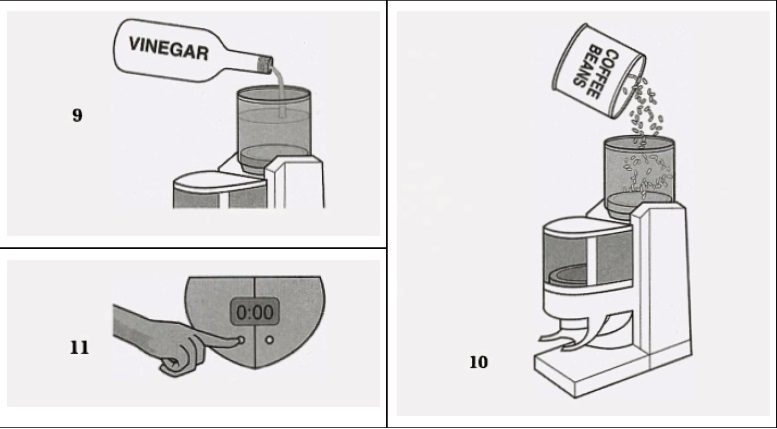
Questions 9-11: Match each picture with the appropriate section A-E in the coffeemaker instructions.
Questions 12-14: Answer using NO MORE THAN THREE WORDS.
Melas of India
A. Kumbh Mela is celebrated every twelve years at four holy places: Prayagraj (Allahabad), Haridwar, Ujjain and Nashik. The grand event is held by rotation, on the banks of the sacred rivers: Godavri, Kshipra, Yamuna and the Ganges, where pilgrims gather for a holy bath. The major attractions of this biggest religious fair are the procession of Naga Sadhus.
B. Sonepur Mela is a cattle fair held on a full moon day in Bihar, on the confluence of rivers Ganges and Gandak. This fair is also known as the Harihar Chhetra Mela, and is the only one of its kind in the world. Haathi Bazaar is one of the major attractions of the fair, where elephants are lined up for sale. Apart from this, all breeds of buffaloes, donkeys, ponies and birds are also available for sale. The largest animal fair in India attracts people from all around Asia.
C. Pushkar Fair is one of the world's largest camel fairs, held in the oldest city of Rajasthan, Pushkar. The fair, held on the banks of the Pushkar Lake, attracts a large number of visitors from all around the world, especially from Israel. It is an important tourist attraction.
D. The Hemis Gompa Fair is a religious fair and one of the most auspicious occasions for the Buddhist community in India. The grand fair is held in the months of January/February at the world famous Hemis Gompa, the biggest Buddhist monastery in Ladakh. The most esoteric of festivities are the mystic mask dances, referred collectively as Chams Performance, which is essentially a part of Tantric tradition, performed only in those gompas which follow the Tantric Vajrayana teachings.
E. Chandrabhaga Mela, also known as Magha Saptam Mela, is held in February at Khandagiri in Bhubaneswar, Orissa. This important fair is celebrated every year during the full moon phase. During the seven day fair thousands of pilgrims gather to bathe in the holy Chandrabhaga river.
F. Gangasagar Mela is the second largest congregation of mankind after the holy Kumbh mela. This big religious fair is held annually where the holy river Ganges meets the Bay of Bengal in West Bengal. During the time of the fair, thousands of people congregate here for a holy bath.
G. Ambubasi Fair: The Ambubasi Fair is one of the numerous religious fairs and festivals celebrated across India. This three-day traditional fair is organized every year during the monsoons in the Kamakhya temple at Guwahati, Assam. Tens of thousands of devotees from different parts of the country throng the Kamakhya Temple for the three-day fair.
H. Baneshwar Fair: The Baneshwar fair is most popular tribal fair held in Dungarpur district in Rajasthan during the month of February. This is a religious fair with simple and traditional rituals to worship Lord Shiva. This fair attracts a large number of tribals from the neighboring state of Madhya Pradesh.
Buying a Blau Automatic Coffeemaker
Thank you for buying a Blau Automatic Coffeemaker. If you use and maintain your Blau product correctly, you will enjoy it for years to come.
A Preparing Coffee with Your Blau Coffeemaker
Your coffeemaker is guaranteed to make a perfect cup of coffee every time. First, fill the reusable coffee basket with coffee grounds, adding two tablespoons of grounds per cup. Next, fill the reservoir with eight ounces of water for each cup of coffee. Place the coffee pot under the coffee basket, making sure that it is directly underneath the drip spout. Press the "on" button located on the coffeemaker's base.
B Built-in Convenience
Your Blau Coffeemaker is equipped with a built-in timer. You can set the timer so that your coffee is ready when you get up in the morning, when you return from work in the evening, or at any other time you choose. Just follow the directions above for preparing your coffee. Then set the timer by pushing the button underneath the clock at the front of the coffeemaker. Push twice to put the clock in timer mode. The minutes will flash. Push the button until the minutes are set. Push twice again and the hours will flash. Push the button until the hours are set. Push twice to return the timer to clock mode.
C Maintaining Your Coffeemaker
Monthly cleaning will keep your coffeemaker functioning properly and your coffee tasting fresh. Just follow these easy steps. Fill the reservoir with a small bottle of vinegar. Turn your coffeemaker on and let the vinegar run through it, filling the coffee pot. Then fill the reservoir with fresh water and let it run through the coffeemaker. Do this twice to make sure all traces of vinegar are removed.
D Really Fresh Coffee
If your Blau Coffeemaker comes equipped with a coffee grinder, then you can enjoy extra fresh coffee every day. Simply add whole beans to the grinder compartment, being careful not to pass the "full" line below the rim. Make sure the lid is securely in place, then press the "grind" button.
E Our Guarantee
Your Blau Coffeemaker has a lifetime guarantee. If your coffeemaker suffers any type of malfunction, just call our toll-free customer service line at 888-936-8721, 24 hours a day. If we are unable to help you over the phone, you may have to mail the coffeemaker to us for service.
1
IELTS Box Matching A-H
1. From start to finish, this mela lasts seven days.
- A Kumbh Mela
- B Sonepur Mela
- C Pushkar Fair
- D Hemis Gompa Fair
- E Chandrabhaga Mela
- F Gangasagar Mela
- G Ambubasi Fair
- H Baneshwar Fair
Answer: E
Explanation: Chandrabhaga Mela is explicitly described as a seven-day fair.
2
IELTS Box Matching A-H
2. The banks of a lake are witness to this mela.
- A Kumbh Mela
- B Sonepur Mela
- C Pushkar Fair
- D Hemis Gompa Fair
- E Chandrabhaga Mela
- F Gangasagar Mela
- G Ambubasi Fair
- H Baneshwar Fair
Answer: C
Explanation: Pushkar Fair is held on the banks of Pushkar Lake.
3
IELTS Box Matching A-H
3. This mela witnesses the largest congregation of mankind.
- A Kumbh Mela
- B Sonepur Mela
- C Pushkar Fair
- D Hemis Gompa Fair
- E Chandrabhaga Mela
- F Gangasagar Mela
- G Ambubasi Fair
- H Baneshwar Fair
Answer: A
Explanation: Kumbh Mela is described as the biggest religious fair, while Gangasagar is second largest after Kumbh.
4
IELTS Box Matching A-H
4. This mela is held during the rainy season.
- A Kumbh Mela
- B Sonepur Mela
- C Pushkar Fair
- D Hemis Gompa Fair
- E Chandrabhaga Mela
- F Gangasagar Mela
- G Ambubasi Fair
- H Baneshwar Fair
Answer: G
Explanation: Ambubasi Fair is held every year during the monsoons.
5
IELTS Box Matching A-H
5. This mela is held at a junction of two rivers.
- A Kumbh Mela
- B Sonepur Mela
- C Pushkar Fair
- D Hemis Gompa Fair
- E Chandrabhaga Mela
- F Gangasagar Mela
- G Ambubasi Fair
- H Baneshwar Fair
Answer: B
Explanation: Sonepur Mela is held at the confluence of the Ganges and Gandak.
6
IELTS Box Matching A-H
6. A lot of people from different tribes come to this mela.
- A Kumbh Mela
- B Sonepur Mela
- C Pushkar Fair
- D Hemis Gompa Fair
- E Chandrabhaga Mela
- F Gangasagar Mela
- G Ambubasi Fair
- H Baneshwar Fair
Answer: H
Explanation: Baneshwar Fair attracts a large number of tribals from the neighboring state of Madhya Pradesh.
7
IELTS Box Matching A-H
7. Only this mela witnesses a larger gathering of visitors.
- A Kumbh Mela
- B Sonepur Mela
- C Pushkar Fair
- D Hemis Gompa Fair
- E Chandrabhaga Mela
- F Gangasagar Mela
- G Ambubasi Fair
- H Baneshwar Fair
Answer: F
Explanation: Gangasagar is described as the second largest congregation after Kumbh Mela, so only Kumbh has a larger gathering.
8
IELTS Box Matching A-H
8. You cannot see the faces of the people dancing at this fair.
- A Kumbh Mela
- B Sonepur Mela
- C Pushkar Fair
- D Hemis Gompa Fair
- E Chandrabhaga Mela
- F Gangasagar Mela
- G Ambubasi Fair
- H Baneshwar Fair
Answer: D
Explanation: Hemis Gompa Fair features mystic mask dances, so the dancers' faces are covered.
9
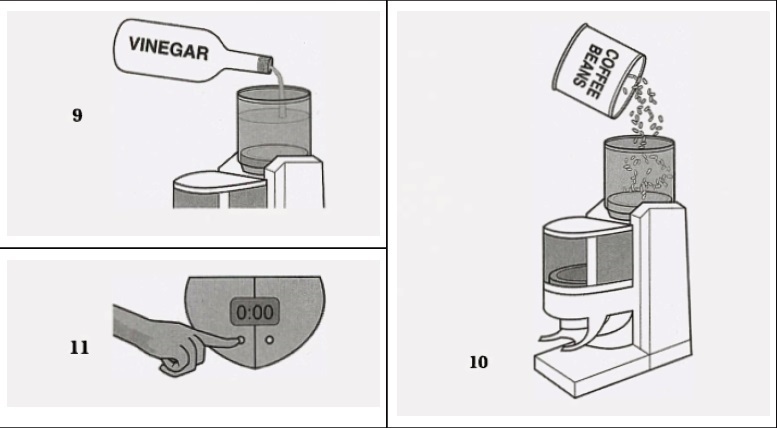
IELTS Box Matching A-H
9. Match this picture below with the appropriate section in the coffeemaker instructions.
- A Preparing Coffee with Your Blau Coffeemaker
- B Built-in Convenience
- C Maintaining Your Coffeemaker
- D Really Fresh Coffee
- E Our Guarantee
Answer: C
Explanation: The picture shows vinegar being poured into the reservoir, matching Section C on monthly cleaning.
10
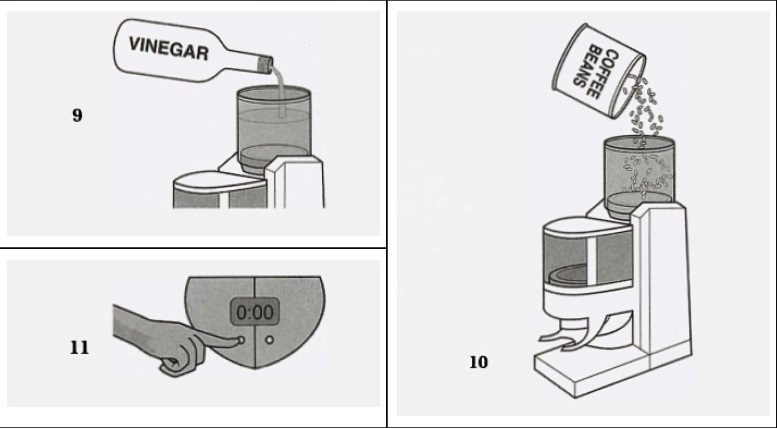
IELTS Box Matching A-H
10. Match this picture below with the appropriate section in the coffeemaker instructions.
- A Preparing Coffee with Your Blau Coffeemaker
- B Built-in Convenience
- C Maintaining Your Coffeemaker
- D Really Fresh Coffee
- E Our Guarantee
Answer: D
Explanation: The picture shows coffee beans being added to the grinder compartment, matching Section D on fresh coffee.
11
IELTS Box Matching A-H
11. Match this picture below with the appropriate section in the coffeemaker instructions.
- A Preparing Coffee with Your Blau Coffeemaker
- B Built-in Convenience
- C Maintaining Your Coffeemaker
- D Really Fresh Coffee
- E Our Guarantee
Answer: B
Explanation: The picture shows the built-in clock/timer controls, matching Section B.
12
Short Answer
12. How much water should you use to make one cup of coffee?
Answer: EIGHT OUNCES|8 OUNCES
Explanation: Section A says to use eight ounces of water for each cup of coffee.
13
Short Answer
13. How often should you clean the coffee maker?
Answer: ONCE A MONTH|MONTHLY
Explanation: Section C says monthly cleaning keeps the coffeemaker functioning properly.
14
Short Answer
14. How can you contact the company for assistance?
Answer: BY PHONE|BY TELEPHONE|PHONE|TELEPHONE
Explanation: Section E provides a toll-free customer service phone number available 24 hours a day.
Section 2 - Questions 15-27
Questions 15-21: Choose NO MORE THAN TWO WORDS from the text for each answer.
Questions 22-27: Complete the sentences with NO MORE THAN TWO WORDS AND/OR A NUMBER.
Discipline and Punctuality at Workplace
Discipline and punctuality are the two most essential traits required in a professional to be successful. Discipline ensures individuals behave in an acceptable way at the workplace and also adhere to the rules and regulations of the organization. Individuals who are disciplined are not only successful professionally but also in their personal lives. Disciplined employees are liked and appreciated by not only their superiors but also other fellow workers.
Misbehaving at the workplace spoils the entire work culture eventually leading to zero or very less productivity. You need to understand that there is a difference between office and home and you just can't behave in the same way at work as you behave at home.
Would you be able to concentrate on your work if the colleague sitting next to you is constantly over the phone and chatting with his girlfriend? Obviously, NO. In fact no one can. Discipline ensures individuals maintain silence at workplace and work as a single unit with their team members to achieve organization goals and objectives. Discipline is in fact the lifeline of an organization.
Punctuality ensures employees attend office daily and also complete their working hours. Managers need to ensure that their team members reach office on time and do not unnecessarily sit till late. It is always better to leave on time and come back fresh and completely recharged the next day. Believe me, individuals who are not punctual are often not reliable.
How would you feel if you want to meet someone on an urgent basis and if the other person never comes on time and always comes up with a new excuse? Would you ever believe or want to meet this person again? Being late to meetings is indeed a crime in today's business scenario where your client has access to unlimited alternatives just at the click of a button. Discipline and punctuality make you a confident professional. Employees who concentrate on their work rather than interfering in their colleague's, finish their work on time and do not have to sit beyond the working hours. Trust me, being disciplined and punctual allow you to enjoy your work and the office never becomes a boring place. Disciplined employees seldom find their names dragged into controversies or nasty politics. Trust me, no one would respect you if you are not disciplined and punctual.
Make a Day Trip to the Taj Mahal from Delhi
The first option I'm going to talk about is to just add Agra into your itinerary and go there by public transportation from Delhi then move on to the next place from Agra. The problem with this is that going onward from Agra sometimes means going back to Delhi as it's a big hub to catch long trains and buses. Because of this, passing through Agra isn't always a great option but you should see if it works for you.
Public transportation is easy and there are many buses that go from Delhi to Agra throughout the day. If you want to get there for sunrise you need to leave by 3.30 in the morning. Women traveling solo might not be okay with that, so in that case, I recommend not taking a local bus but instead a "tourist bus". Here's some information about booking buses in India. Keep in mind during some times of the year, there is too much fog to drive on the highway that early in the morning and tours will not run.
If you're more interested in taking a "tourist bus" this would mean booking it either online at makemytrip.com or redbus.in if you can get your international card to work. You can also just pop into any tourist agency (you'll see them everywhere) or ask your hotel to book this for you. Prices for a local bus could be as cheap as 50 rupees while a tourist bus might cost you 400 rupees. Moving on to more options, you might prefer a private A/C car ride there. These can be arranged through your hotel or an agency once you reach there. They will charge you commissions on this which could be quite high. If you would rather book this ahead of time with a reputable company then I recommend either of these two options:
1. Get Your Guide $80. This tour started at $17 and has gone up in price as it's become so popular, which is a little sad but at least you know it's good. 321 people have given this "tour" a 4.8/5 star rating. They will pick you up from your hotel in Delhi and get you to the Taj Mahal by sunrise, then take you back to Delhi. The tour pass allows you to skip the line at the Taj Mahal and you also get taken to Agra Fort and Mumtaz Mahal. The price does not include entrance tickets but there is a guide who will go with you through the attractions. This translates to about 1000 rupees which is literally a better deal than you can find anywhere. This price will fluctuate as the peak tourist season rises and falls.
2. Viator $80. This is actually a better deal. 96 people have given it a 5-star review. With this option, the entrances to the Agra Fort and Taj Mahal are both included as well as breakfast. I think the entrance to both would cost around $20 so it saves you that money. Lunch isn't included and they take you to a 5-star hotel buffet - so that's a little bit up to you if you want to pay for a lunch like that or if it's just you and your friends on the tour you can say no thank you to stopping at the hotel. Prices also go up if you are just one person.
3. Viator Shopping Tour $25. This is a kind of weird one but might work for some people. You go to Agra from Delhi and see the Taj Mahal from the outside for sunrise, don't go in, and then do a unique shopping tour. Like the others, it's a return trip back to Delhi but you could just stay in Agra and then the next day go to the Taj Mahal and go inside. The price is so cheap that it's kind of like paying for a ride there and getting a free shopping tour before you explore Agra on your own. Someone will go to the Taj with you so they can take your picture in front of it and help keep people from swarming you for selfies. It's so affordable and booking it ahead would just take off all your stress.
15
Short Answer
15. There are ______ very important requirements for a working person to be successful.
Answer: TWO
Explanation: The opening sentence identifies discipline and punctuality as the two most essential traits.
16
Short Answer
16. An employee must not conduct himself the way he does at ______ when he comes to work.
Answer: HOME
Explanation: The passage says there is a difference between office and home.
17
Short Answer
17. If somebody in your workplace is engaging in casual conversation, you cannot ______ on your work.
Answer: CONCENTRATE
Explanation: The passage asks whether a person could concentrate while a colleague is constantly chatting.
18
Short Answer
18. The ______ of an organization is discipline.
Answer: LIFELINE
Explanation: The passage explicitly states that discipline is the lifeline of an organization.
19
Short Answer
19. You would not ______ someone who always has a reason to be late.
Answer: BELIEVE
Explanation: The passage asks whether you would believe a person who repeatedly arrives late with new excuses.
20
Short Answer
20. If you are disciplined and punctual, it will make you a ______ professional.
Answer: CONFIDENT
Explanation: The passage says discipline and punctuality make you a confident professional.
21
Short Answer
21. Employees who focus on their work do not have to stay at the office post ______ hours.
Answer: WORKING
Explanation: Focused employees finish work on time and do not sit beyond working hours.
22
Short Answer
22. Based upon the time of the year, the buses may not be plying to Agra because of too much ______.
Answer: FOG
Explanation: The passage says tours may not run when there is too much fog on the highway early in the morning.
23
Short Answer
23. If you want to book a bus online, your ______ has to work.
Answer: INTERNATIONAL CARD
Explanation: Online tourist-bus booking depends on getting your international card to work.
24
Short Answer
24. One of the options to book a tour to Agra is to ask a ______, which are available in plenty.
Answer: TOURIST AGENCY
Explanation: The passage says you can use any tourist agency, which are seen everywhere.
25
Short Answer
25. The price of the Get Your Guide tour has increased manifold because it is extremely ______.
Answer: POPULAR
Explanation: The tour price has gone up as it has become so popular.
26
Short Answer
26. If you want to have your breakfast as part of the tour, you should book the ______ tour.
Answer: VIATOR
Explanation: The Viator $80 option includes breakfast.
27
Short Answer
27. The tour that costs $25 is the only one where you also get to go on a ______ in Agra.
Answer: SHOPPING TOUR
Explanation: The $25 option is explicitly a Viator Shopping Tour.
Section 3 - Questions 28-40
Questions 28-31: Reading Passage 3 has nine paragraphs, A-I. Write the correct letter A-I.
Questions 32-36: Decide whether the statements agree with the passage.
| TRUE | if the statement is True |
| FALSE | if the statement is false |
| NOT GIVEN | if the information is not given in the passage |
Questions 37-40: Complete the summary using the list of words A-K below.
| A tariffs | D output | G trade | I fares |
| B components | E employees | H freight | J software |
| C container ships | F insurance costs | K international standards | |
Delivering the goods
The vast expansion in international trade owes much to a revolution in the business of moving freight
A International trade is growing at a startling pace. While the global economy has been expanding at a bit over 3% a year, the volume of trade has been rising at a compound annual rate of about twice that. Foreign products, from meat to machinery, play a more important role in almost every economy in the world, and foreign markets now tempt businesses that never much worried about sales beyond their nation's borders.
B What lies behind this explosion in international commerce? The general worldwide decline in trade barriers, such as customs duties and import quotas, is surely one explanation. The economic opening of countries that have traditionally been minor players is another. But one force behind the import-export boom has passed all but unnoticed: the rapidly falling cost of getting goods to market. Theoretically, in the world of trade, shipping costs do not matter. Goods, once they have been made, are assumed to move instantly and at no cost from place to place. The real world, however, is full of frictions. Cheap labour may make Chinese clothing competitive in America, but if delays in shipment lie up working capital and cause winter coats to arrive in spring, trade may lose its advantages.
C At the turn of the 20th century, agriculture and manufacturing were the two most important sectors almost everywhere, accounting for about 70% of total output in Germany, Italy and France, and 40-50% in America, Britain and Japan. International commerce was therefore dominated by raw materials, such as wheat, wood and iron ore, or processed commodities, such as meat and steel. But these sorts of products are heavy and bulky and the cost of transporting them is relatively high.
D Countries still trade disproportionately with their geographic neighbours. Over time, however, world output has shifted into goods whose worth is unrelated to their size and weight. Today, finished manufactured products dominate the flow of trade, and, thanks to technological advances such as lightweight components, manufactured goods themselves have tended to become lighter and less bulky. As a result, less transportation is required for every dollar's worth of imports or exports.
E To see how this influences trade, consider the business of making disk drives for computers. Most of the world's disk-drive manufacturing is concentrated in South-east Asia. This is possible only because disk drives, while valuable, are small and light and so cost little to ship. Computer manufacturers in Japan or Texas will not face hugely bigger freight bills if they import drives from Singapore rather than purchasing them on the domestic market. Distance therefore poses no obstacle to the globalisation of the disk-drive industry.
F This is even more true of the fast-growing information industries. Films and compact discs cost little to transport, even by aeroplane. Computer software can be 'exported' without ever loading it onto a ship, simply by transmitting it over telephone lines from one country to another, so freight rates and cargo-handling schedules become insignificant factors in deciding where to make the product. Businesses can locate based on other considerations, such as the availability of labour, while worrying less about the cost of delivering their output.
G Many countries' deregulation has helped to drive the process along. But, behind the scenes, a series of technological innovations known broadly as containerisation and intermodal transportation has led to swift productivity improvements in cargo-handling. Forty years ago, the process of exporting or importing involved a great many stages of handling, which risked portions of the shipment being damaged or stolen along the way. The invention of the container crane made it possible to load and unload containers without capsizing the ship and the adoption of standard container sizes allowed almost any box to be transported on any ship. By 1967, dual-purpose ships, carrying loose cargo in the hold and containers on the deck, were giving way to all-container vessels that moved thousands of boxes at a time.
H The shipping container transformed ocean shipping into a highly efficient, intensely competitive business. But getting the cargo to and from the dock was a different story. National governments, by and large, kept a much firmer hand on truck and railroad tariffs than on charges for ocean freight. This started changing, however, in the mid-1970s, when America began to deregulate its transportation industry. First airlines, then road hauliers and railways, were freed from restrictions on what they could carry, where they could haul it and what price they could charge. Big productivity gains resulted. Between 1985 and 1996, for example, America's freight railways dramatically reduced their employment, trackage, and their fleets of locomotives - while increasing the amount of cargo they hauled. Europe's railways have also shown marked, albeit smaller, productivity improvements.
I In America the period of huge productivity gains in transportation may be almost over, but in most countries the process still has far to go. State ownership of railways and airlines, regulation of freight rates and toleration of anti-competitive practices, such as cargo-handling monopolies, all keep the cost of shipping unnecessarily high and deter international trade. Bringing these barriers down would help the world's economies grow even closer.
28
IELTS Box Matching A-H
28. A suggestion for improving trade in the future.
- A Paragraph A
- B Paragraph B
- C Paragraph C
- D Paragraph D
- E Paragraph E
- F Paragraph F
- G Paragraph G
- H Paragraph H
- I Paragraph I
Answer: I
Explanation: Paragraph I says reducing state control, freight-rate regulation and anti-competitive practices would help international trade.
29
IELTS Box Matching A-H
29. The effects of the introduction of electronic delivery.
- A Paragraph A
- B Paragraph B
- C Paragraph C
- D Paragraph D
- E Paragraph E
- F Paragraph F
- G Paragraph G
- H Paragraph H
- I Paragraph I
Answer: F
Explanation: Paragraph F explains that software can be transmitted electronically, making freight rates and cargo schedules far less important.
30
IELTS Box Matching A-H
30. The similar cost involved in transporting a product from abroad or from a local supplier.
- A Paragraph A
- B Paragraph B
- C Paragraph C
- D Paragraph D
- E Paragraph E
- F Paragraph F
- G Paragraph G
- H Paragraph H
- I Paragraph I
Answer: E
Explanation: Paragraph E says importing disk drives from Singapore does not create hugely bigger freight bills than buying them domestically.
31
IELTS Box Matching A-H
31. The weakening relationship between the value of goods and the cost of their delivery.
- A Paragraph A
- B Paragraph B
- C Paragraph C
- D Paragraph D
- E Paragraph E
- F Paragraph F
- G Paragraph G
- H Paragraph H
- I Paragraph I
Answer: D
Explanation: Paragraph D explains that goods have become lighter and less bulky relative to their value, reducing transport needs per dollar of trade.
32
True / False / Not Given
32. International trade is increasing at a greater rate than the world economy.
Answer: TRUE
Explanation: Paragraph A says the world economy is growing at just over 3% a year while trade volume is growing at about twice that rate.
33
True / False / Not Given
33. Cheap labour guarantees effective trade conditions.
Answer: FALSE
Explanation: Paragraph B says cheap labour may create an advantage, but shipping delays and other frictions can remove it; therefore it does not guarantee successful trade.
34
True / False / Not Given
34. Japan imports more meat and steel than France.
Answer: NOT GIVEN
Explanation: The passage does not compare Japanese and French imports of meat and steel.
35
True / False / Not Given
35. Most countries continue to prefer to trade with nearby nations.
Answer: TRUE
Explanation: Paragraph D states that countries still trade disproportionately with their geographic neighbours.
36
True / False / Not Given
36. Small computer components are manufactured in Germany.
Answer: NOT GIVEN
Explanation: The passage discusses disk-drive manufacturing in South-east Asia and does not state that small computer components are manufactured in Germany.
37
IELTS Box Matching A-H
37. Modern cargo-handling methods have had a significant effect on ______ as the business of moving freight around the world becomes increasingly streamlined.
- A tariffs
- B components
- C container ships
- D output
- E employees
- F insurance costs
- G trade
- H freight
- I fares
- J software
- K international standards
Answer: G
Explanation: The summary refers to the significant effect of modern cargo-handling on trade.
38
IELTS Box Matching A-H
38. Manufacturers of computers are able to import ______ from overseas rather than having to rely on a local supplier.
- A tariffs
- B components
- C container ships
- D output
- E employees
- F insurance costs
- G trade
- H freight
- I fares
- J software
- K international standards
Answer: B
Explanation: The passage uses disk drives/components as the example of computer manufacturers importing small, valuable components from overseas.
39
IELTS Box Matching A-H
39. The introduction of ______ has meant that bulk cargo can be safely and efficiently moved over long distances.
- A tariffs
- B components
- C container ships
- D output
- E employees
- F insurance costs
- G trade
- H freight
- I fares
- J software
- K international standards
Answer: C
Explanation: Container ships and containerisation made large-scale cargo movement safer and more efficient.
40
IELTS Box Matching A-H
40. Governments still need to reduce ______ in order to free up the domestic cargo sector.
- A tariffs
- B components
- C container ships
- D output
- E employees
- F insurance costs
- G trade
- H freight
- I fares
- J software
- K international standards
Answer: A
Explanation: Paragraphs H and I describe tariffs and regulation as barriers that keep domestic transport costs high.
Other Tests