Solution for: CBT GT Reading Test 1: Events Taking Place at Tour Historic Houses in Sydney
Answer Table
1.R
2.V
3.G
4.V
5.E
6.O
7.S
8.Q
9.B
10.G
11.J
12.F
13.B|D
14.B|D
15.D|F
16.D|F
17.LID|THE LID
18.STEAM WAND|STEAM PIPE|PIPE
19.WATER TANK
20.PROFESSIONAL MEDICAL HELP|MEDICAL HELP|PROFESSIONAL HELP
21.THIS MANUAL|THE MANUAL|MANUAL
22.DVDS AND POSTERS|DVDs AND POSTERS
23.YOUR PROGRESS|YOUR OWN PROGRESS
24.REAL PATIENT|PATIENT
25.KEY TERMS
26.CASE STUDIES
27.STUDY QUESTIONS
28.D
29.E
30.C
31.G
32.A
33.F
34.B
35.C
36.A
37.ALARM BELLS
38.DIAL LOCKS
39.DIGITAL TECHNOLOGY
40.CONVENTIONAL KEYS
Exam Review
Section 1 — Questions 1–14
Section 1
Answer Questions 1–14 using the reading material in this section.
Questions 1-5: Read the information below about events taking place at four Historic Houses in Sydney.
OUT OF THE WOODWORK
The festival of traditional woodwork
ROUSE HILL ESTATE
7 & 8 November 10am-5pm
On this beautiful rural property, once occupied by six generations of one family, you can watch talented craftsmen at work and learn about the construction of houses and farm buildings in the early 19th century.
Bring the family and enjoy a weekend that includes live music, kids’ activities, arts and crafts, and much more.
GOVERNMENT HOUSE
Sunday 6 March 3pm-7pm
Treat yourself to a musical feast for an autumn afternoon in the gardens and grounds of Government House, listening to some of Sydney’s best musicians.
Government House was built between 1837 and 1845 and sits within an important historic garden with exotic trees, pathways, and terraces.
Bring a picnic or just a rug and purchase something from the selection of refreshments available.
Grounds open daily 10am-4pm
ELIZABETH FARM
Weekend 14 & 15 November
Come and enjoy the fruits of the olive tree, open air dining, and experience the music and dance of the Mediterranean region at our Olive Festival.
The olive, now part of Australia’s modern multi-cultural society, is an important aspect of our history. Today the oldest olive tree in the country, planted at Elizabeth Farm in 1805, is the inspiration for the festival.
Open daily 10am-5pm
Vaucluse House
Sunday 27 November 6pm-9pm
The Jazz Festival is the longest running and most successful of the Historic Houses musical events.
On a perfect summer’s evening, pack a picnic dinner, come along with friends or family and enjoy some of Sydney’s best jazz in the idyllic gardens of Vaucluse House.
Vaucluse House is the only surviving example in Sydney of a 19th-century estate overlooking the harbour, with house, stables and outbuildings, set in its own magnificent gardens.
Questions 6-12: Read the City Cycle Guide.
City Cycle Guide
Helpful tips for new cyclists:
Your local bike shop is the best place for advice on:
- bike set-up - a simple adjustment can make cycling safer and more comfortable
- condition of brakes, tyres, chain, gears, etc.
- lights, bells, helmets, locks, luggage carriers
- reflective or fluorescent and specialist clothing for cycling in the rain.
Good Cycling code
- Traffic regulations apply to cyclists.
- Cycling is permitted on all roads apart from motorways, as well as many places where motor vehicles are not permitted.
- It is illegal for cyclists to ignore red lights, disobey ‘one-way’ and other road signs or to ride on the pavement and areas that are exclusively for pedestrians.
- The police have powers to impose a £30 fine for cycling offences.
Cyclists’ Touring Club (CTC)
The national cyclists’ organisation CTC works for all cyclists and has developed national standards and accreditation for cycling training. It offers legal advice, cheap insurance and organises tours and social events. Adult joining fee is £32 or five years for the price of four at £128.
Questions 13-14: Read the Emergency Fire Procedures.
Mitchell College
Emergency Fire Procedures
If you discover a fire, you should
- sound the fire alarm
- report the fire to Reception from any of the green phones in the building
- evacuate (leave) the building and go to your meeting point.
If you hear the fire alarm
- leave the room immediately via the nearest safe exit, shutting the doors behind you
- do not use the lift
- do not take any personal belongings
- assist disabled people and visitors to leave the building
- go to the arranged meeting point
- do not return to the building until the fire safety officer has told you it is safe to do so.
1
IELTS Box Matching A-H
1 a demonstration of 19th century skills
- G Government House
- R Rouse Hill Estate
- E Elizabeth Farm
- V Vaucluse House
Answer: R
Explanation: Answer supplied by the user.
2
IELTS Box Matching A-H
2 the first event ever run by the Historic Houses Trust
- G Government House
- R Rouse Hill Estate
- E Elizabeth Farm
- V Vaucluse House
Answer: V
Explanation: Answer supplied by the user.
3
IELTS Box Matching A-H
3 a garden performance with refreshments on sale
- G Government House
- R Rouse Hill Estate
- E Elizabeth Farm
- V Vaucluse House
Answer: G
Explanation: Answer supplied by the user.
4
IELTS Box Matching A-H
4 a view of the water
- G Government House
- R Rouse Hill Estate
- E Elizabeth Farm
- V Vaucluse House
Answer: V
Explanation: Answer supplied by the user.
5
IELTS Box Matching A-H
5 a celebration of early Australian agriculture
- G Government House
- R Rouse Hill Estate
- E Elizabeth Farm
- V Vaucluse House
Answer: E
Explanation: Answer supplied by the user.
6
IELTS Box Matching A-H
Your bike is …….6……. and comfortable.
- A benefits
- B bicycles
- C clean
- D contours
- E difficult
- F entertainment
- G fined
- H hurt
- I insurance
- J lawyers
- K lost
- L motorists
- M pedestrians
- N people
- O reliable
- P rocky
- Q rules
- R signs
- S wet
Answer: O
Explanation: Answer supplied by the user.
7
IELTS Box Matching A-H
They also have a wide range of accessories for sale, such as specialist gear for …….7……. conditions.
- A benefits
- B bicycles
- C clean
- D contours
- E difficult
- F entertainment
- G fined
- H hurt
- I insurance
- J lawyers
- K lost
- L motorists
- M pedestrians
- N people
- O reliable
- P rocky
- Q rules
- R signs
- S wet
Answer: S
Explanation: Answer supplied by the user.
8
IELTS Box Matching A-H
You need to be aware of the …….8……. of the road, as these apply to everyone, not just motorists.
- A benefits
- B bicycles
- C clean
- D contours
- E difficult
- F entertainment
- G fined
- H hurt
- I insurance
- J lawyers
- K lost
- L motorists
- M pedestrians
- N people
- O reliable
- P rocky
- Q rules
- R signs
- S wet
Answer: Q
Explanation: Answer supplied by the user.
9
IELTS Box Matching A-H
Although ……...9…….. are often allowed to go where many others may not, if you break the law, you run the risk of getting …….10……. .
- A benefits
- B bicycles
- C clean
- D contours
- E difficult
- F entertainment
- G fined
- H hurt
- I insurance
- J lawyers
- K lost
- L motorists
- M pedestrians
- N people
- O reliable
- P rocky
- Q rules
- R signs
- S wet
Answer: B
Explanation: Answer supplied by the user.
10
IELTS Box Matching A-H
Although ……...9…….. are often allowed to go where many others may not, if you break the law, you run the risk of getting …….10……. .
- A benefits
- B bicycles
- C clean
- D contours
- E difficult
- F entertainment
- G fined
- H hurt
- I insurance
- J lawyers
- K lost
- L motorists
- M pedestrians
- N people
- O reliable
- P rocky
- Q rules
- R signs
- S wet
Answer: G
Explanation: Answer supplied by the user.
11
IELTS Box Matching A-H
Members can get help from …….11……. and take part in tours and specially arranged …….12……. .
- A benefits
- B bicycles
- C clean
- D contours
- E difficult
- F entertainment
- G fined
- H hurt
- I insurance
- J lawyers
- K lost
- L motorists
- M pedestrians
- N people
- O reliable
- P rocky
- Q rules
- R signs
- S wet
Answer: J
Explanation: Answer supplied by the user.
12
IELTS Box Matching A-H
Members can get help from …….11……. and take part in tours and specially arranged …….12……. .
- A benefits
- B bicycles
- C clean
- D contours
- E difficult
- F entertainment
- G fined
- H hurt
- I insurance
- J lawyers
- K lost
- L motorists
- M pedestrians
- N people
- O reliable
- P rocky
- Q rules
- R signs
- S wet
Answer: F
Explanation: Answer supplied by the user.
13
IELTS A/B/C Choice Style
Question 13. Question 13: Which TWO things must you do if the fire alarm goes off?
Answer: B|D
Explanation: Answer supplied by the user.
14
IELTS A/B/C Choice Style
Question 14. Question 14: Which TWO things must you do if the fire alarm goes off?
Answer: B|D
Explanation: Answer supplied by the user.
Section 2 — Questions 15–27
Section 2
Answer Questions 15–27 using the Coffee World and First Aid texts.
Questions 15-19: Read the Coffee World course information.
Become a professional barista -
Sign up for a “Coffee World” coffee-making course today
The Coffee World course deals with the practical skills and knowledge required to make and serve a great cup of coffee, from selecting the right beans, using and caring for an expresso coffee machine, to final presentation.
It covers essentials such as storage of coffee beans, as well as machine care and maintenance procedures. Each successful student will receive a copy of our Coffee World instruction booklet on how to keep your coffee machine in top working order.
The course is limited to six students per class so everyone is kept busy from start to finish with ‘hands-on’ experience. At the end of the course, the students are assessed by our experienced trainers for their national barista certificate.
Extract from the booklet
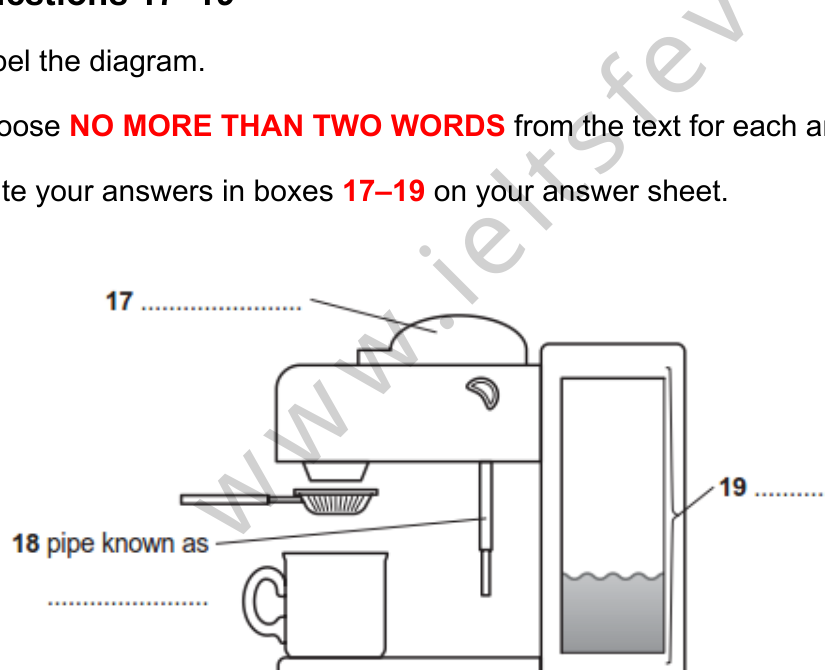
Every coffee machine is a bit different. For simplicity, this diagram illustrates a single-reservoir steam machine. The raised area on the top of the machine is called the lid. This is where you put the beans. Just below this is the steam valve. In the centre of the machine is a pipe through which the steam can exit, which is used to froth up the milk. The technical name for this pipe is the steam wand. The wand can also be used for warming cups.
The model shown here has one single water tank. The water is heated in this tank in all steam machines.
Questions 20-27: Read the text below.
Why You Should Complete
A First Aid Course
People need to know what to do in an emergency before medical help arrives. A First Aid course will prepare you to make appropriate decisions regarding first aid care and to act on those decisions.
The first critical step in any emergency depends on someone being there who will take the right action. After completing the course you should be able to:
- recognise when an emergency has occurred
- follow the step-by-step plan of action for any emergency
- provide care for injuries until the arrival of professional medical help.
How you will learn
Course content is presented in various ways. This manual, which is essential reading for everyone undertaking a First Aid course, contains the information that will be discussed in class. DVDs and posters will support this information, as well as discussions and other class activities. The audio-visual materials will emphasise the key points to remember when making decisions in emergencies and will help you provide appropriate care. Participating in all class activities will increase your confidence in your ability to be effective.
The course has been designed to enable you to evaluate your own progress in terms of skills, knowledge and decision-making. Certain chapters in the manual include practice sessions that are designed to help you learn specific first aid skills. Many of these skills can be practised with another student. This will give you a sense of what it would be like to care for a real patient in an emergency situation and help reduce any concerns you may have about providing care.
The manual
This manual has been designed to facilitate your learning and understanding of the material presented in it. It includes the following features.
At the beginning of each chapter there is a list of key terms with definitions. You will need to know these terms to understand the contents of each chapter.
Case studies are included in all the chapters and are easily recognised as they appear in yellow-coloured boxes. They present a variety of material ranging from historical information to application of the information in the text. You will not be tested on these case studies.
At the end of each chapter you will also find study questions that have been designed to test your memory and understanding of chapter content. The answers are in Appendix A.
15
IELTS A/B/C Choice Style
Question 15. Question 15: Which TWO topics are mentioned in the text?
Answer: D|F
Explanation: Answer supplied by the user.
16
IELTS A/B/C Choice Style
Question 16. Question 16: Which TWO topics are mentioned in the text?
Answer: D|F
Explanation: Answer supplied by the user.
17
Short Answer
Question 17. Label the diagram.
Answer: LID|THE LID
Explanation: Answer supplied by the user.
18
Short Answer
Question 18. Label the diagram. pipe known as
Answer: STEAM WAND|STEAM PIPE|PIPE
Explanation: Answer supplied by the user.
19
Short Answer
Question 19. Label the diagram.
Answer: WATER TANK
Explanation: Answer supplied by the user.
20
Short Answer
The course will equip you to provide care while waiting for …………………………………
Answer: PROFESSIONAL MEDICAL HELP|MEDICAL HELP|PROFESSIONAL HELP
Explanation: Answer supplied by the user.
21
Short Answer
You must read………………………………… if you undertake this course.
Answer: THIS MANUAL|THE MANUAL|MANUAL
Explanation: Answer supplied by the user.
22
Short Answer
Everything you learn is backed up by visual material in the form of both …………………………………
Answer: DVDS AND POSTERS|DVDs AND POSTERS
Explanation: Answer supplied by the user.
23
Short Answer
The course allows you to assess …………………………………in three main areas.
Answer: YOUR PROGRESS|YOUR OWN PROGRESS
Explanation: Answer supplied by the user.
24
Short Answer
Working with another student helps you become more confident about looking after a .…………………………………
Answer: REAL PATIENT|PATIENT
Explanation: Answer supplied by the user.
25
Short Answer
A knowledge of the …………………………………will help you understand what each chapter in the manual is about.
Answer: KEY TERMS
Explanation: Answer supplied by the user.
26
Short Answer
A knowledge of the …………………………………will not count towards your final assessment.
Answer: CASE STUDIES
Explanation: Answer supplied by the user.
27
Short Answer
Use the …………………………………to help you remember the information.
Answer: STUDY QUESTIONS
Explanation: Answer supplied by the user.
Section 3 — Questions 28–40
Section 3
Answer Questions 28–40 using the text “Unlocking the history of locks and keys”.
Unlocking the history of locks and keys
{A} Keys have always represented authority, security, and power. Kings, emperors, court nobles, and cities and towns across the globe have incorporated the symbol of the key into banners, coats of arms, and official seals. The delivery of keys to a castle, fortress, or city was a symbolic event, as is the presentation of the Key-to-the-City today to a visiting dignitary. It was a way of showing people that they were both welcome and trusted.
{B} Many centuries ago in ancient Egypt, the importance of the ‘head of the household’ was determined by the number of keys he owned. These were large keys and were carried by slaves on their shoulders. If he had several slaves or key bearers, he was considered to be a man of great wealth and distinction. And in this tradition, through the ages, the lock and its key have become an intricate part of our culture. Locking up personal property, the key symbolizes our desire for privacy and security for our possessions.
{C} The earliest known locks date back well over 3,000 years. They were made of wood and were large and crude in design, yet their principle of operation was the forerunner of the modern pin-tumbler locks in use today. Since the earliest times, chests were secured with strong and often very large locks. They were used to protect precious metals, money, jewels, to store clothing, and church vestments, archives and arms, linens and other household articles, bridal dresses, and even for the burial of important people. Chest locks were ornamented for household use or were very plain and sturdy for chests that were to be transported. So the design and appearance of a lock usually depended on the use to which that lock would be put.
{D} Padlocks were known to the ancient Greeks, Romans, Egyptians and other cultures including the Chinese, and were particularly favoured because they were portable. It is generally believed that the padlock was first used as a ‘travel’ lock to safeguard merchandise from thieves along ancient trade routes and seaboards and waterways where commerce was centred. Brass and iron padlocks found in Europe and the East were popularized by the Romans and the Chinese.
{E} Another type of padlock, the push-key padlock, was of simple construction, the bolt being kept in the locked position by the projection of a spring or springs. To unlock, the springs were compressed or flattened by the key, which freed the bolt and permitted it to slide back. Padlocks were often highly decorated with dragons, horses, dogs and even elephants, and were presented in pairs as gifts, with congratulatory messages. For better efficiency, letter locks, otherwise known as combination padlocks, were later developed, which eliminated the need for an actual key and worked by aligning letters or numbers on revolving disks. Padlocks were used throughout the centuries to lock up prisoners as well as possessions. They were usually made of iron, bronze or brass, and were rough in construction, but had the disadvantage of being easy to defuse.
F Throughout the 14th and 15th centuries in Europe, there was little significant improvement made in the design of locking mechanisms, although ornamentation became increasingly important. Craftsmen at this time excelled in metalwork and designed and produced locks for gates, doors, chests and cupboards. This was the age of the 'Masterpiece’ lock, that had to be designed and produced as one-of-a-kind by a journeyman locksmith, in order to qualify him as a Master. Masterpiece locks, which were never actually used on a door, were often displayed without covers to show the component parts of the mechanisms, their functions, the decoration and the method of assembly.
G During the era of the Renaissance in the 15th and 16th centuries in Europe, master locksmiths were inspired to produce the most intricate and the finest ornamental locks of all time. This was the period when iron craftsmen and lock artisans were highly sought after and became internationally famous. They excelled in the forging, embossing, engraving, and etching of metals, and were invited to make locks and keys for many of the great courts of Europe.
Beating the burglars
When lock-picking became prevalent in the 18th century, the inventor met the challenge of confounding the burglar with increasingly complicated locking mechanisms. Among the new improvements were keys with changeable bits, as well as alarm bells and what were known as ‘puzzle’ padlocks. These early puzzle padlocks had from three to seven rings of characters or letters which released the lock when properly aligned. Dial locks were similar in operation, and both types were set to be unlocked by words or patterns of numbers known only to the owners or responsible persons.
The introduction of digital technology in the late 20th century revolutionised the science of locks and security systems. But despite the advances made in this field, most of us still rely on conventional keys to lock our front doors or start the car, possibly because we prefer the mechanical satisfaction of turning a key to remembering a security number.
(1) apprentice, someone who is learning his/her trade
(2) the art of opening a lock without a key, usually illegally
28
IELTS Box Matching A-H
(28) the reason why a certain lock was used to protect goods for sale
- A Paragraph A
- B Paragraph B
- C Paragraph C
- D Paragraph D
- E Paragraph E
- F Paragraph F
- G Paragraph G
Answer: D
Explanation: Answer supplied by the user.
29
IELTS Box Matching A-H
(29) an explanation of how a particular lock works
- A Paragraph A
- B Paragraph B
- C Paragraph C
- D Paragraph D
- E Paragraph E
- F Paragraph F
- G Paragraph G
Answer: E
Explanation: Answer supplied by the user.
30
IELTS Box Matching A-H
(30) examples of the relationship between form and function
- A Paragraph A
- B Paragraph B
- C Paragraph C
- D Paragraph D
- E Paragraph E
- F Paragraph F
- G Paragraph G
Answer: C
Explanation: Answer supplied by the user.
31
IELTS Box Matching A-H
(31) a time when locksmiths were in big demand
- A Paragraph A
- B Paragraph B
- C Paragraph C
- D Paragraph D
- E Paragraph E
- F Paragraph F
- G Paragraph G
Answer: G
Explanation: Answer supplied by the user.
32
IELTS Box Matching A-H
(32) reference to an ancient ceremony
- A Paragraph A
- B Paragraph B
- C Paragraph C
- D Paragraph D
- E Paragraph E
- F Paragraph F
- G Paragraph G
Answer: A
Explanation: Answer supplied by the user.
33
IELTS Box Matching A-H
(33) how certain lock-making skills were tested
- A Paragraph A
- B Paragraph B
- C Paragraph C
- D Paragraph D
- E Paragraph E
- F Paragraph F
- G Paragraph G
Answer: F
Explanation: Answer supplied by the user.
34
IELTS Box Matching A-H
(34) the use of keys as a measure of a person’s social status
- A Paragraph A
- B Paragraph B
- C Paragraph C
- D Paragraph D
- E Paragraph E
- F Paragraph F
- G Paragraph G
Answer: B
Explanation: Answer supplied by the user.
35
IELTS A/B/C Choice Style
Question 35. {35} According to the writer, early padlocks were popular because they were
Answer: C
Explanation: Answer supplied by the user.
36
IELTS A/B/C Choice Style
Question 36. {36} What does the writer say about Masterpiece locks?
Answer: A
Explanation: Answer supplied by the user.
37
Short Answer
Security mechanisms have included: keys with changeable bits; (37)…………………………………; puzzle padlocks
Answer: ALARM BELLS
Explanation: Answer supplied by the user.
38
Short Answer
Security mechanisms have included: puzzle padlocks; (38)…………………………………
Answer: DIAL LOCKS
Explanation: Answer supplied by the user.
39
Short Answer
In recent years, alternative methods of security have been made possible by (39)…………………………………
Answer: DIGITAL TECHNOLOGY
Explanation: Answer supplied by the user.
40
Short Answer
However, people continue to prefer (40)…………………………
Answer: CONVENTIONAL KEYS
Explanation: Answer supplied by the user.